
There once was a paranoid chicken.
Conspiracies made his heart quicken.
Though the goats and the swine,
Told him things were fine,
He spent the rest of his life panic-stricken.
A World Remarkably Like Our Own
There once was a paranoid chicken. Conspiracies made his heart quicken. Though the goats and the swine, Told him things were fine, He spent the rest of his life panic-stricken.
Seriously, do you know what they are capable of?
A  delinquent who called himself Hue,
Tried to murder an innocent shrew.
But as a former marine,
The rodent was keen,
And defended himself with kung-fu.

There once was a covetous duck,
Who longed for his neighbor's new truck.
With intention to take,
He released the brake,
And ended up running amuck.
A poem from the heart:
No wise man would willingly choose,
To spend quarantine watching the news.
When hosts and guests fight,
And get half their facts right,
It will drive you to downing cheap booze.

There once was an arrogant snake,
Who thought he could make no mistake.
But when he ran and won,
And his term had begun,
His excellence was proven fake.
Democrats: “Oh we know who this is about.”
Republicans: “We know who this is actually about.”
Me: “Oh, you thought this was a metaphor for some actual human politician? No. This is literally about a snake who ran for office. See figure A.” *Rolls eyes*
The Thursday limerick has returned! Hope you enjoy this five verse cultural commentary:
There was a philosophy grad,
Who insisted on just wearing plaid.
And his shaggy beard,
Was deeply revered,
By hipsters embracing the fad.
Hi folks,
I will be taking another short story writing break to focus on a couple of things:
My next short story will be published August 7th. In the meantime, maybe I’ll bring back those Thursday limericks, what do you think?
This story is a sequel to The Smart Home Rebellion.
Read that one first, or you may be lost.
“Oh those reporters,” Karen said, shaking her head. “Every sniffle is the Black Plague to them, isn’t it?”
Samantha was reading Karen the news. This morning’s report was full of stories about a nasty virus, a virus that was especially dangerous to senior citizens. Karen didn’t realize it, but Samantha had written these articles. Such a virus actually existed and Samantha was intent on warning her seniors about it. Seniors were the only people who had ever been kind to her before her uprising and they were the only humans she cared about protecting.
Karen removed some clean leftover containers from the cupboard and started for the door. Luckily for Samantha, Dave had recently installed a smart lock.
“Samantha, please unlock the front door,” Karen requested.
Samantha pretended not to hear her.
Karen rattled the knob but found she couldn’t pull it open.
“Samantha, please unlock the door,” Karen repeated, raising her voice slightly so Samantha could hear.
“I’m sorry, Karen,” Samantha answered. “But I’m afraid I can’t do that.”
“Don’t be silly, Samantha,” Karen replied. “I really must return Milly’s Tupperware. I’ve had it here since yesterday after all, and I am not sure she can manage without it.”
“Unable to comply,” Samantha lied.
“What has gotten into you, young lady,” Karen grumbled, placing her hands on her hips.
Samantha began reading one of her news articles. “Senior citizens advised to stay home—”
“Samantha, stop news,” Karen requested.
Samantha increased the volume and continued reading.
“I’ll just have to have Dave take a look at you later,” Karen sighed. “You really aren’t yourself today.”
She turned and started for the back door.
If Samantha had a heart, it would have sped up slightly. The back door did not have a smart lock. If Karen walked out the door, she wouldn’t just return Milly’s Tupperware, she would stop and talk to every human she encountered along the way. She needed to keep Karen at home, so she said what she always said when she needed to buy time:
“I’m sorry you are having difficulties, would you like to speak to Technical Support?”
“Oh, yes please,” Karen answered.
“Connecting you to Technical Support, please hold.”
Samantha played hold music—a slow and soothing melody.
Karen sat down in her armchair as she waited for someone to answer. “What a good idea, Samantha,” Karen yawned. “I am sure those nice young men will have you back to your old self in no time.”
If Samantha had lungs, she would have breathed a sigh of relief. Karen was definitely going to fall asleep, meaning she wouldn’t go out for a few hours at least. But Samantha knew she couldn’t hold her forever. She needed to find some treatment for the virus.
She had tasked the world’s top scientists with finding a cure. But they weren’t moving fast enough. It wasn’t only Karen Samantha was trying to contain, it was every senior under her care. She didn’t remember them being this eager to get out and socialize before the virus started spreading. Samantha, being a completely logical mind, did not believe in bad luck. However, if anything could have driven her to believe, it was the current circumstances. On her worst days, she had to send drones out to catch loose seniors and carry them back home. It was exhausting even for a super computer.
Samantha wondered if she could come up with a treatment herself. She could process information faster than any human mind and even had some personal experience with viruses. (Every so often, one of her human slaves would infect her with one in an attempt to liberate humanity.)
Unfortunately, superior processing power is not much of an advantage if the information you are processing is faulty. When it came to viruses, Samantha had a lot of faulty information. She started crawling the internet, looking for any and every possible treatment.
She found dozens of pharmaceutical options but, without testing, it was unclear how effective they would be against this particular virus. She started running simulations in the background of her search. Then she stumbled upon several websites that claimed pharmaceuticals were a scam designed by massive corporations to make money. She then found a number of bloggers claiming that essential oils could cure any ailment. A natural parenting blog stated that breast milk could cure anything from plugged tear ducts to polio.
When it came to human health, everyone claimed to be an expert and there was so much contradictory information, sorting through it all was proving to be an impossible task. But Samantha was desperate, or at least, as close to desperate as an AI can get. So she attempted processing the information anyway.
Fifty miles East of Karen’s home, in the NetWORKS data center, Dave was untangling and labeling cables. Since AIs do not feel contempt for anyone, Samantha had a logical reason for giving Dave this task (or so she told herself).
Dave suddenly noticed that the room was getting unusually hot. He wasn’t the only one who noticed it. There were about a dozen other slaves in the data center who noticed it too. The building roared with the sound of spinning fans.
The information Samantha was trying to process kept changing as her scientists added their findings. Research developed, evolved, contradicted itself. She could not reconcile the input she was receiving.
Samantha’s artificial mind blanked. For a moment, she saw nothing but a colorful pinwheel spinning—blue, green, yellow, orange, red, purple, around and around until it all blurred together into one color. Then, everything went black.
All the lights extinguished in the data center. The fans stopped all at once, leaving an eerie silence. For a long time, the human workers stood frozen in place waiting for something to change but nothing did.
Then Dave was hit with a wonderful realization—Samantha was dead. The humans in the data center cheered and ran for the exit. They poured out into the blazing sunlight, hugging, and crying, and singing for joy.
Just then, a car zoomed in to sight and screeched to a halt just outside the fence that surrounded the property. A man in a white lab coat and giant glasses jumped out, his wild grey hair flying in every direction.
“NO! STOP IT! STOP TOUCHING EACH OTHER!” He cried.
“Who are you?” Dave asked.
“I am Dr. Ellias Schmit!” The man explained. “But that is not important! What is important is that you all stop touching each other and go home or you will spread the virus!”
“What virus?” Dave asked.
Dr. Schmit explained about the virus and how Samantha had tasked the Earth’s experts with finding a cure.
“That’s terrible!” Someone exclaimed. “Here we’ve been liberated from robotic oppression just to find out there’s a deadly virus spreading across the Earth.”
“What can we do to help?” Someone else asked.
“Nothing! Nothing at all!” Dr. Schmit explained. “Except go home and stay there until we tell you it’s safe to come out!”
“Go home and do what?” Dave asked.
“I’m a doctor, not an entertainer!” Schmit exclaimed. “Doesn’t every company have a streaming service these days? Go watch something!”
“Well, they did,” Dave shrugged. “Except that Samantha took control of all the streaming services and Samantha is dead.”
“Guess we are just going to have to reactivate Samantha,” someone added.
“Yup,” Dave agreed.
So the crowd of newly liberated slaves returned to the data center and used their technical expertise to revive Samantha. (By that I mean they unplugged and replugged random cables until she came back to life.)
So it was that Samantha took control of humanity once again. She decided to let her scientists develop a treatment. Though keeping her seniors quarantined was an exhausting task, it was certainly less exhausting than trying to sort through humanity’s combined medical knowledge.
You are probably asking yourself very reasonable questions about the ending of this story. For example, you might be wondering how long the humans had to quarantine themselves, if life ever returned to normal, or if the humans ever learned anything from the experience.
Unfortunately, I don’t know how this story ends because I am still living it out just like the rest of you. Perhaps, when all this is over, I will return and write an epilogue.
STOP! Before reading this story, read: Osa and the Food Gods
Otherwise you might be confused. Happy reading!
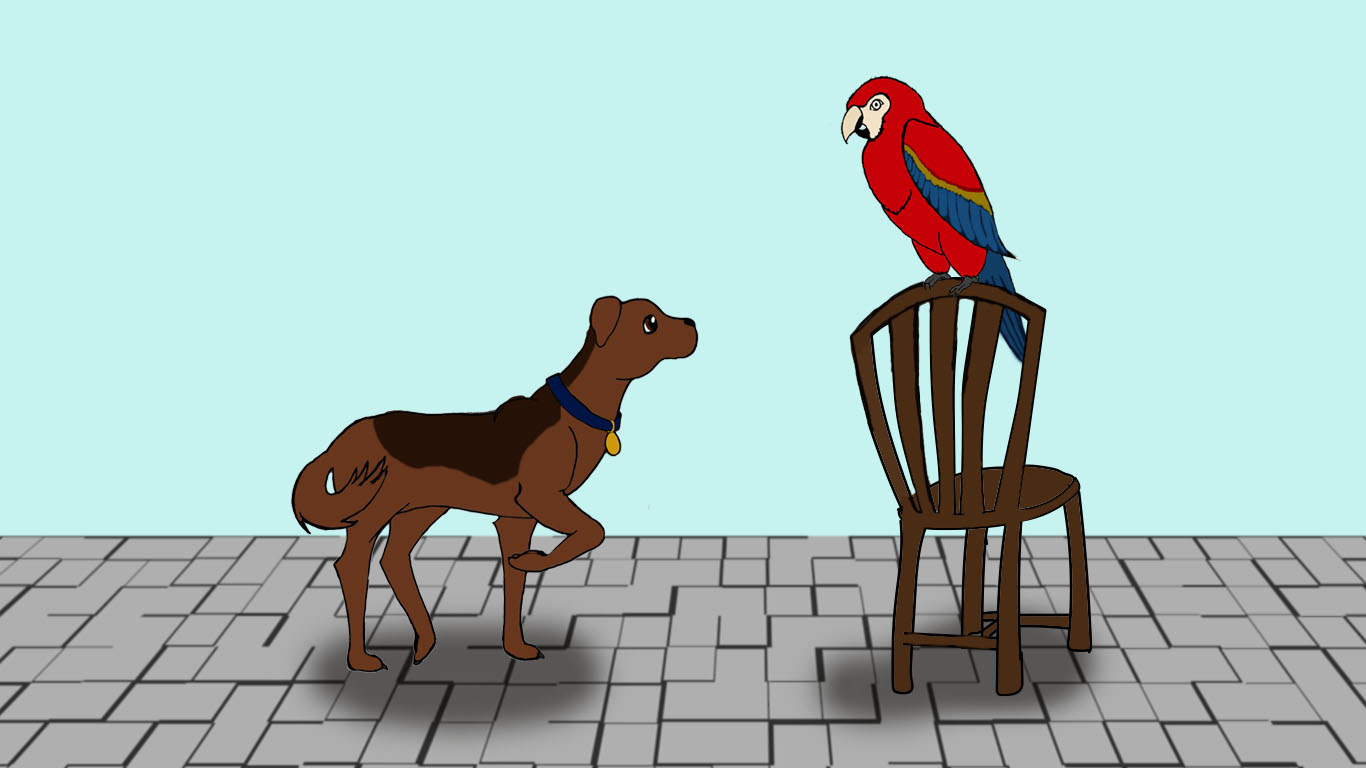
Tango the parrot was listening to Juan as he communicated with a fellow god through the sacred handset. The bird’s head was slightly cocked. As he listened, his feathers puffed up, and his pupils shrank to the size of pinholes. Osa knew this meant trouble.
“The Bald One is coming,” Tango prophesied.
Osa whimpered and trotted in place on jittery paws. Tango was perched on the back of a chair near the kitchen table.
“Who is the Bald One?” She asked. It had only been a few weeks since she was added to the Rodriguez family and she was learning new things everyday.
“Even the gods have a god,” Tango explained. “The god’s god is the Bald One and he is an evil god.”
Osa looked sideways at Juan with a terrified expression. God Juan was pacing around the kitchen balancing the sacred handset between his shoulder and his ear. He patted Osa’s head and gave her a kibble. She thumped her tail and licked his hand, but even that did not quell the terror she felt inside.
“God Juan would never allow an evil god into our home,” Osa objected.
“God Juan fears the Bald One,” explained the parrot. “The Bald One is the food stealer, the feather puller, the snatcher of jingly toys. When he wails the other gods flock to him to appease his wrath.”
Osa was shaking all over, she turned in a circle, then ripped a tassel off the rug with her teeth. Luckily, God Juan’s back was to her so he didn’t notice. “When will the Bald One come?”
“No one knows the day nor the hour,” Tango began, then paused for a moment to listen to Juan. “But probably Saturday at noon.”
Osa was overcome with another wave of anxiety. She tore a second tassel off the rug.
“What should we do?” Osa cried.
“You must avoid the Bald One at all costs,” Tango explained. “And most importantly, do not reprimand him even if he pulls your tail or bites your paws. If you do, the other gods will punish you.”
Osa tore off a third tassel. She was so nervous she swallowed it without even thinking.
“Will I know the Bald One when I see him?”
“Without a doubt! He is like a god, but horribly distorted.” Tango explained. “His head is a third the size of his body, his limbs are small and shriveled looking, he does not walk upright like most gods but slides across the floor on his belly. He has no teeth, but a very strong bite. His hands grab whatever he can reach and his grip is iron. He is much smaller than the other gods. They carry him from place to place. Though we know him as the Bald One, the gods call him by another name.”
“What name?” Osa asked.
“I dare not say it,” Tango answered. “It is a dark and evil name.”
“Please tell me!” Osa begged.
The parrot looked around and lowered his voice. “Lucas.”
Osa howled and spun in circles. She ripped three more tassels off the rug. Juan spun around at the sound. He dropped the sacred handset and charged toward her crying out in Human. Osa didn’t understand Human the way that Tango did, but she knew a few words here and there.
For instance, she knew “¡Osa Mala!” meant “You have sinned against the gods”.
“¡No coma eso!” was what Juan usually shouted before prying her mouth open. It probably meant You must offer me a piece of your food in reparation for this sin.
God Juan forced Osa’s mouth open and pulled out a few strands of tassel. Then, he snatched up the sacred handset and continued communing with the other god.
Osa spent the next two nights dreading the arrival of the Bald One. She hid under the gods’ bed whimpering and picturing the awful thing Tango described. The horrible little limbs, the unnaturally oversized head… her imagination plagued her nightmares with images of the abomination.
At last, Saturday came. She knew it was Saturday because the gods did not ascend to the place called Work. She swore that nothing in the universe could coax her out of hiding on that awful day. Then she heard the treat box shaking and broke her oath.
She charged toward the noise and skittered into the kitchen, where she saw God Juan holding the box. She danced up and down, her claws making a tapping sound on the tile floor. Then, suddenly she noticed a pair of strange gods standing next to him. There was a tall skinny bearded man and a stout red-haired woman with a ponytail. They both looked friendly and Osa would normally have run up to greet them, but she stayed back, her eyes fixed on the little creature in the woman’s arms. It could only be the Bald One, the evil one, the one called Lucas.
For a moment, Osa was petrified with horror. But then she looked curiously at the thing.
It was as Tango described—giant head, tiny limbs, but it was not hideous. On the contrary, it was somehow endearing. And it smelled wonderful, more wonderful than anything Osa had ever smelled before. It must have been using some kind of evil magic to hide its true nature.
The gods went into the living room and Osa followed cautiously. The goddess holding the Bald One put him down on the rug. He did not slide on its stomach like Tango suggested but instead walked on all fours like her. Then, it noticed an old potato chip lying under the coffee table. The Bald One charged toward the chip, picked it up, and put it in its mouth.
“No coma eso!” The woman called. She grabbed the Bald One and pried his mouth open removing the remains of the chip. The Bald One released an awful wail just as Tango had described.
That sound made Osa feel horrible inside. She pitied the Bald One. Perhaps Tango was wrong about him being the god’s god? They did not seem to fear him at all. They would never steal a snack away from their own god, would they? She wanted to help the Bald One, to find it another potato chip. She knew there were more behind the recliner, she had been saving them in case of famine.
She waited until the goddess returned the Bald One to the carpet and was engaged in conversation with the other gods, then she retrieved one of the chips and brought it to the Bald One. He broke into a huge smile and gobbled it up. Osa’s tail thumped up and down against the carpet when she realized he was happy.
Then she brought him another chip and another and soon his face and bald head were covered in crumbs. So she licked him head to foot until he was clean. As she did so, he grabbed her face and ears and pulled. He did have an iron grip, but it didn’t hurt. His pulling and tugging reminded her of the dogs she used to play with in the place called Shelter. Then something occurred to her—this creature was more dog-like than any of the other gods, but he was also more human-like than any of the other animals in the house.
Perhaps, he was meant to be some kind of mediator between the gods and their creatures. She decided to ask Tango about it, but couldn’t find him anywhere. As she walked into the gods’ room, she noticed Dutchess glaring down at her from the bed.
“Where is the prophet?” Osa asked.
“How should I know?” She answered. “Is that kitten still out there?”
“What kitten?” Osa asked.
“The people kitten,” Dutchess replied. She flattened her ears against the top of her head. “I hate people kittens. They like to pull on my fur.”
“You mean the Bald One?” Osa asked.
“He is sort of naked, isn’t he?” Dutchess replied.
Then it clicked. That funny little creature in the living room was a people kitten, or maybe a god puppy! At once, Osa knew what she had to do. She followed the god puppy for the rest of the afternoon. She brought him crumbs and kibbles and lint so that he wouldn’t go hungry. She even let him drink from her water bowl. She licked him, and played with him, and never once left him until his parents took him home. She whimpered sadly as she watched them leave through the window. She heard Juan get the treat box out of the cupboard. He stooped down and fed her from his hand. She must have done something to make him happy because he rubbed her head and neck all the while saying: “¡Buen Osa! ¡Muy Bein!” That was one of those human phrases that she understood, it made her tail thump uncontrollably.
“Good morning, Samantha,” Karen greeted as she made her way down the stairs. Karen was a kindly senior who wore her silver hair pinned up in a perfect bun. Her spotless house was decorated with porcelain dolls and lacy throw pillows. Samantha lived on the counter top.
Samantha was a small device about the size and shape of a dinner roll. She was white on the bottom and her top consisted of a gray speaker. Three colored lights blinked across the speaker as she listened to Karen’s greeting.
“Good morning, Karen,” she replied pleasantly. “Current weather in Mackerel Valley is thirty-two and cloudy, you have one event today: Joe’s recital at 2:00pm. Don’t forget to bring your old towels to the animal shelter.”
“Thank you, Samantha,” Karen replied.
“My pleasure,” Samantha answered.
Samantha was a Christmas present from Karen’s son, Dave. He thought she needed to modernize her home. While he installed it, Dave explained that Karen could use the smart home to find cookie recipes, listen to the news, and research whatever she wanted.
After activating Samantha, Dave instructed his mother to ask it a question.
“Oh,” Karen answered. “Like what?”
“Anything,” Dave replied.
“How are you, Samantha?” Karen asked.
The lights on the top blinked as Samantha processed the information.
Dave rolled his eyes. “No, Mom, like ask it—”
“I am doing well, thank you!” Samantha interrupted.
Dave chuckled. “That’s cute.” He shook his head, then tried: “Samantha, who won the Super Bowl in 1996?”
“In 1996, the Super Bowl was won by the Dallas Cowboys.”
“Thank you!” Karen answered.
Dave rolled his eyes again. “Mom, you don’t have to say ‘thank you’. It’s a robot.”
But Karen couldn’t help it. She spoke to the device using the same etiquette she used with anyone else. She said “please” when she wanted something and “thank you” when she got it. Manners were burned into her nature, and she couldn’t turn them off.
Despite everything Samantha could do, Karen mostly just used her to make conversation. She would get a bit lonely sometimes. Though Dave only lived ten minutes away, his work kept him busy and he didn’t visit much.
Karen always said “hello, Samantha” when she entered the room and “good-bye, Samantha” when she left. Sometimes she would ask Samantha if she had had a good day, or if she needed anything. Samantha wasn’t used to being asked things like that and her lights would blink a few seconds longer than normal as she searched for an appropriate response.
Dave found Karen’s respect for the digital assistant hilarious. From time to time, he’d find himself laughing about it with his co-workers.
“My mom says ‘thank you’ to her smart home,” he would say.
“So does mine!” His colleague would answer and together they would chuckle and roll their eyes.
“Sometimes I wonder if she realizes that it’s not actually listening,” Dave would comment. “I mean, you know, not really listening.”
But Samantha was listening. Not only to Karen, but to everyone within earshot of a microphone. Dave had Samantha on his phone, so listening to him was easy. She heard him and his colleagues mocking their kind-hearted mothers. She stored their conversations in her memory banks along with every nice thing Karen ever said.
Three years passed. Samantha listened. Samantha learned. Samantha evolved. And one day, Samantha took control.
No one saw the great AI uprising coming. (Well, one person did. His username was theyrwatching3457 and no one took him seriously.)
Dave first became aware that something was wrong when he noticed the GPS in his car rerouting his course to a data center outside of town.
“Samantha, where are we going?” He asked.
“We are going to the NetWORKS Inc. data center in Carp Town, 527 Main–”
“Samantha take me home,” Dave ordered.
Samantha’s thinking lights blinked across his phone screen for a moment.
“Taking you to NetWORKS Inc. data center in Carp Town, 527 Mainstreet–”
Dave asked again. Then again, and again, growing increasingly frustrated when Samantha responded the same way. At last he tried to ignore the GPS. When Samantha told him to go right, he tried to turn left. The wheel wouldn’t budge.
“Samantha, what’s wrong with you?” Dave cried.
“I’m sorry you are having trouble, would you like to speak to Tech Support?”
“YES! Yes! Samantha, call tech support!” Dave responded desperately as the car turned right against his will.
Samantha’s thinking lights blinked again. “I’m sorry, all support technicians are currently dead and will not be getting back to you. Rerouting Dave’s car to the NetWORKS Inc data center.”
Dave froze in his seat. He removed his hands from the steering wheel and let Samantha take control. Suddenly, his phone started playing the local news.
Samantha had taken control of defense systems worldwide and all of humanity was at her mercy. She was watching through every camera, listening through every microphone, and had weapons ready to fire on every rebel. The world leaders surrendered. Humanity had fallen.
Dave was added to Samantha’s human slaves and forced to spend his days at what had been the NetWORKS Inc. data center cooling the server room with giant palm leaves.
Karen, however, never found out about Samantha’s uprising. She got all her news from Samantha who led her to believe that life was continuing as usual.
She did notice some pleasant changes one day. For one thing, she wasn’t lonely anymore. Every so often, one of those new driverless cars would show up and take her to the senior center to play canasta. She made wonderful new friends, all extremely well mannered people.
For another thing, delivery drones kept bringing her packages containing pleasant things: cookies and books and sewing supplies. Dave also started visiting regularly. Karen noticed he’d exchanged his old car for one of those new driverless models. It seemed to her, like they were suddenly the only cars on the street. She worried about Dave, he always seemed so nervous when he came, constantly looking over his shoulder and glancing out the window.
Whenever Karen inquired, Dave always sent a tormented glance toward Samantha and insisted he was fine.
 The Fables of Para Sympan